You pick up a piece of jewelry and feel drawn to it before you understand why. The color, the weight, the quiet glow of a stone against your palm. That pull isn’t random, gemstone meanings have guided how people choose and wear stones for thousands of years, and those meanings shape how we give, wear, and remember the pieces closest to us.
At Odense Bijoux, every stone in our natural gemstone collections is chosen with intention. The meaning behind a piece is part of its design, a philosophy, not just a tagline. Whether you’re choosing something for yourself or searching for a gift that goes beyond the surface, understanding what different stones symbolize gives you a framework that makes the decision feel right, not just pretty.
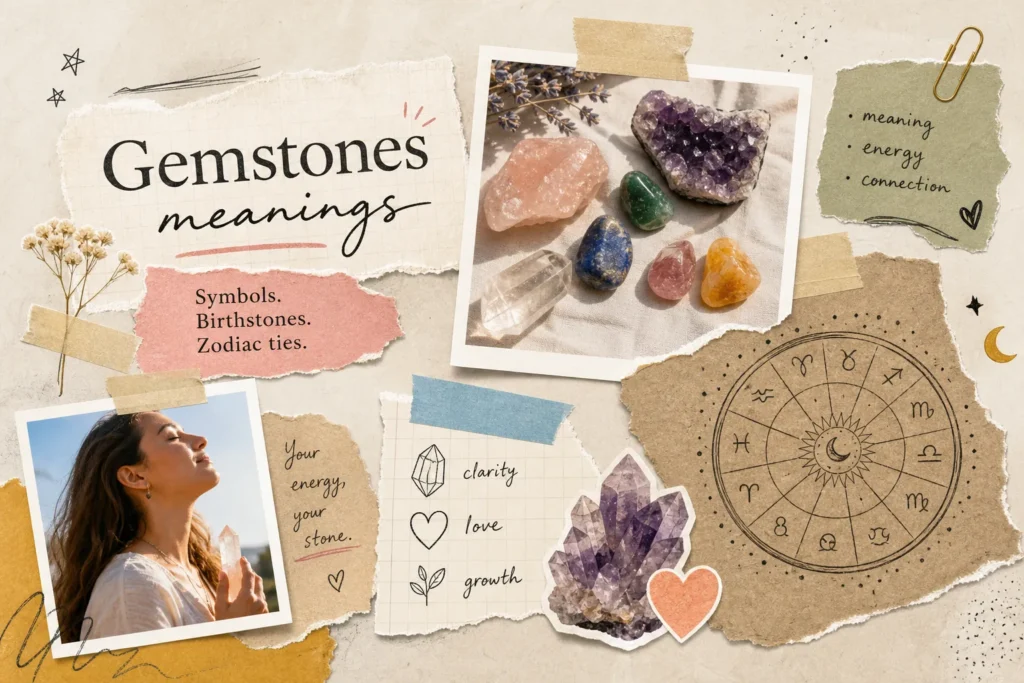
This guide covers the symbolic meanings of the most popular gemstones, how birthstone traditions work, which stones align with each zodiac sign, and how to hold folklore and science in the same hand without confusion.
Why the stones you wear carry more than beauty
The ancient roots of gemstone symbolism
Gemstone symbolism is not a modern wellness trend. Ancient cultures attributed profound spiritual importance to certain stones, lapis lazuli was prized across the ancient world for its connection to the heavens and the afterlife. Roman soldiers wore red stones as protective talismans in battle. Rubies were associated with power and divine favor in many royal traditions across history. These weren’t decorative choices. They were intentional acts of meaning-making, rooted in the belief that the natural world held power that could be worn and carried.
The Gemological Institute of America formalized gemology as a science in the 1930s and introduced the 4Cs grading system in 1953. That scientific framework focuses on optical properties, geological formation, and quality grading. The cultural lore, however, predates those standards by millennia. Both layers, the scientific and the symbolic, coexist. Understanding that distinction helps you appreciate each for what it actually offers.
How meaning shapes the way we experience jewelry
When you know that amethyst is historically tied to calm and clarity, wearing it shifts how it feels on your wrist. The stone doesn’t change, but your relationship to it does. Meaningful jewelry becomes part of a daily ritual rather than just an accessory you grabbed on the way out. That shift is exactly what separates a thoughtful, curated collection from an impulse buy that sits unworn in a drawer.
Popular gemstone meanings you should know
Stones of emotional healing: amethyst and rose quartz
Amethyst takes its name from the Greek amethystos, meaning “not drunk.” Historically associated with sobriety, clarity, and spiritual protection, it was worn by ancient Greeks who believed it shielded against intoxication and clouded thinking. It’s February’s birthstone, connected to the Crown Chakra in crystal healing traditions, and traditionally paired with Aquarius and Pisces. For anyone who wants a stone that represents quiet strength and inner peace, amethyst is the natural choice.
Rose quartz is the universal stone of love. Its soft pink color reflects its reputation for nurturing energy, covering self-love, romantic love, and compassion in equal measure. Tied to Libra and the Heart Chakra, it works beautifully as a gift for someone rebuilding after a difficult season, or as a daily reminder to extend kindness inward. Many designers favor both stones for delicate settings because of their color and long-standing sentimental associations.
Stones of luck, serenity, and timeless elegance: jade and pearl
Jade holds one of the longest and richest symbolic histories of any stone. In Chinese culture, Confucius described it as embodying eleven virtues, including kindness, loyalty, and wisdom. In Mesoamerican traditions, its green color represented water, corn, and the cycle of life. For the Māori, the green stone called Pounamu carried spiritual power and ancestral connection. Across all three traditions, jade carries meaning, serenity, luck, and a grounded prosperity that feels earned rather than flashy.
Pearl is the only gemstone formed within a living creature. That origin gives it a symbolism all its own: transformation, purity, and wisdom revealed over time. Cultures from ancient China to Rome to India have prized pearls as markers of status and grace. They are June’s birthstone and are closely connected to the moon, the sea, and feminine intuition. Jade and pearl sit at the center of Odense Bijoux’s collections for exactly this reason, they are wearable expressions of meaning that don’t shout.
Stones of strength and clarity: emerald, sapphire, and garnet
Emerald is May’s birthstone and one of history’s most storied gems. Its vivid green carries associations with fertility, hope, and renewal. Sapphire, September’s stone, has been worn by royalty and clergy for centuries as a symbol of wisdom, loyalty, and mental clarity. Garnet anchors January with its deep red warmth, representing trust, passion, and grounded devotion, a stone long associated with protection and enduring love.
Birthstone meanings by birth month
January through June: warmth and renewal
The birthstone tradition traces back to the Breastplate of Aaron described in the Book of Exodus, which featured twelve stones representing the twelve tribes of Israel. That list was later linked to the zodiac, then gradually standardized. In 1912, the American National Association of Jewelers (now Jewelers of America) formalized the modern list, though many of the traditional associations predate that standardization by centuries. Here’s how the first half of the year breaks down:
- January: Garnet (loyalty, passion, grounded devotion)
- February: Amethyst (clarity, spiritual protection, inner calm)
- March: Aquamarine (courage, calm); Bloodstone (traditional: healing)
- April: Diamond (purity, strength, enduring love)
- May: Emerald (hope, vitality, renewal)
- June: Pearl, Moonstone, or Alexandrite (intuition, balance, purity)
July through December: passion, wisdom, and mystery
The second half of the year brings some of the most vivid and emotionally resonant stones in the tradition:
- July: Ruby (love, passion, vitality)
- August: Peridot (light, clarity, inner strength)
- September: Sapphire (wisdom, loyalty, calm focus)
- October: Opal or Tourmaline (imagination, balance, emotional healing)
- November: Topaz or Citrine (confidence, joy, manifestation)
- December: Turquoise, Tanzanite, or Blue Topaz (protection, spiritual depth)
Birthstone jewelry remains one of the most personal gifts you can give. It connects the recipient to their place in the calendar and, by extension, to their identity. That’s why it works so consistently for birthdays, anniversaries, and milestone moments across every age and relationship.
Stone symbolism by zodiac sign
How zodiac energy shapes stone pairings
Zodiac-based stone pairings work differently from birthstone logic. Where birthstones connect to a calendar month, zodiac pairings focus on the archetypal energy of each sign, amplifying its strengths or balancing its edges. A Scorpio doesn’t automatically gravitate toward November’s topaz; they might be drawn to obsidian because it mirrors their depth and capacity for transformation. This approach is about personality and intention, not just timing.
Quick reference: gemstone meanings matched to your sign
| Sign | Stones | Qualities |
|---|---|---|
| Aries | Diamond, Bloodstone | Drive, courage |
| Taurus | Emerald | Grounded abundance |
| Gemini | Pearl, Agate | Communication, adaptability |
| Cancer | Moonstone, Jade | Nurturing, emotional depth |
| Leo | Garnet, Onyx | Radiant confidence, strength |
| Virgo | Amethyst, Sapphire | Clarity, focused intention |
| Libra | Rose Quartz, Opal | Beauty, balance |
| Scorpio | Obsidian, Topaz | Depth, transformation |
| Sagittarius | Labradorite, Tanzanite | Freedom, vision |
| Capricorn | Garnet, Ruby | Ambition anchored in loyalty |
| Aquarius | Amethyst, Aquamarine | Originality, clarity of thought |
| Pisces | Aquamarine, Rose Quartz | Empathy, spiritual depth |
If zodiac-aligned jewelry appeals to you, the Odense Bijoux Astre collection translates these traditional pairings into delicate, wearable pieces designed around each sign’s energy and its stone’s symbolism, not just aesthetics.
What crystal traditions say (and where science draws the line)
Crystal healing traditions attribute specific metaphysical properties of stones to their energetic character: amethyst is said to calm anxiety and activate the Crown Chakra, citrine to build confidence through the Solar Plexus, moonstone to support emotional balance, jade to ground and draw prosperity, garnet to fuel passion and motivation. These crystal meanings draw from Ayurvedic practice, European medieval lore, and folk traditions across continents. They are pre-scientific by definition, but they are deeply human.
The GIA focuses on geological formation, optical properties, and grading standards, it does not endorse healing claims. Crystal healing attributions remain metaphysical, not empirically verified. You don’t have to believe in energetic frequencies to appreciate what a stone means to you. Symbolism is personal. Choosing amethyst because it represents the kind of clarity you’re working toward is meaningful regardless of whether the stone itself does anything beyond looking beautiful on your wrist. The gemstone properties you carry are as much about intention as about the stone itself.
How to use gemstone meanings to choose a stone for yourself or someone you love
Finding your entry point
Choosing a gemstone, for yourself or as a gift, usually comes down to one of three starting places, and you don’t have to commit to just one.
Start with birth month if you want the most traditional route. Pairing the stone to the recipient’s birthday creates an instantly personal connection with no explanation required. Start with zodiac energy if the person feels strongly connected to their sign, a zodiac-aligned stone feels tailored rather than generic. Or start with intention: ask what you want the piece to represent. Calm and clarity lead to amethyst. New love or self-compassion points to rose quartz. Prosperity and grounding call for jade.
These lenses don’t compete with each other. Use one, two, or all three to narrow your choice. The result is always a piece that carries a reason, which is what makes jewelry memorable rather than merely decorative.
Choosing fine jewelry that carries meaning
A meaningful stone only does its work when the setting honors it. A delicate bezel or a fine gold frame doesn’t compete with the stone; it lets the stone speak. That’s the principle behind every piece in Odense Bijoux’s natural gemstone collections. From jade to pearl to amethyst, each stone is set in a way that keeps the meaning at the center of the design, not buried under ornamentation.
The meaning behind the stone is the story you carry
Gemstone symbolism has always been a way for humans to make the invisible visible, to wear intention, mark a moment, or carry something that says, quietly, this is who I am or who I’m becoming. That tradition endures across cultures and centuries because it speaks to something fundamental about how we relate to the natural world.
Exploring gemstone meanings, whether through birth month, zodiac connection, or personal intention, adds a layer of significance that mass-market jewelry rarely offers. The piece becomes a talisman, a gift with a story, a daily anchor rather than just an accessory. Browse the Odense Bijoux collection and find the stone that speaks to where you are right now.